We've all heard the uses of liquid nitrogen and its unique properties that help scientists around the world discover new and amazing things. However, without the proper liquid nitrogen equipment and other precautions, the substance can quickly become very dangerous to those around the substance.
Recently, an astrophysicist in Egypt was cooling a charged coupled device camera for the observatory's telescope. He was carrying a cryogenic storage vacuum flask of liquid nitrogen which was to contain the heat coming off of the camera. The flask exploded, giving the astrophysicist severe chest and hand cold burns from the bursting liquid nitrogen.
Liquid nitrogen transfers to nitrogen gas of a rapid ration of 1:694, which is why the substance exploded. If you pour two gallons of liquid nitrogen into any warm vacuum it suddenly and immediately evaporates into a gas in front of your eyes. The properties of the substance are very dangerous for those who are unfamiliar with the safety precautions or liquid nitrogen equipment.
The gas is used for observatory and lab work but is more commonly used in refrigeration. Foods and goods can be transported around the world with the use of cryogenic storage. Liquid nitrogen is also vital in the cryopreservation of blood, reproductive cells and other biological samples.
It's also used in low temperature medical treatment in some dermatology cases. Also, construction companies may be able to use liquid nitrogen to freeze damaged water pipes and stopping water leaks during the fixing process. In the military, liquid nitrogen is used in heat-seeking missiles to prevent sensors from getting confused by their own heat signals or by the heat form the planes that are launching them.
There are so many applications of liquid nitrogen, but you need the proper liquid nitrogen equipment to ensure that the safety of everyone is preserved.
Showing posts with label liquid nitrogen. Show all posts
Showing posts with label liquid nitrogen. Show all posts
Tuesday, January 31, 2012

Tuesday, December 20, 2011
Handling Liquid Nitrogen and Liquid Nitrogen Equipment
Handling liquid nitrogen and liquid nitrogen equipment can be very dangerous, so there will be a need for extreme precaution for everyone who is involved. Liquid nitrogen is a dangerous material that can cause burns and loss of oxygen levels in the air. For example, if a 10 liter dewar is spilled in an unventilated 274 square foot room with an 8 foot ceiling, the oxygen levels would reduce to 19.5 percent. There would be a need for air respirators. Of course, this is a small room and most labs and classrooms are much larger and the oxygen levels should remain relatively high during a spill. However, when transporting the liquid nitrogen and liquid nitrogen equipment in a truck or van is a different story.
But suffocation isn't the main problem with liquid nitrogen and liquid nitrogen equipment. Freeze burns are a much more serious danger. This will cause the greatest concern when building an LN2 freezer.
These are the things that you should be worried when dealing with liquid nitrogen:
- Splatters, especially in eyes, while pouring
- Flying pieces of frozen objects
- Touching the nitrogen or other cold objects
So it's important to stress several precautions which include no touching and the use of goggles. Whenever pouring liquid nitrogen, it can splatter or spew out frozen pieces. It's also important to wear gloves and use tongs to handle any object that is being placed in or out of liquid nitrogen.
When handling liquid nitrogen and liquid nitrogen equipment, it's important to ensure safety to avoid any possible injuries.
But suffocation isn't the main problem with liquid nitrogen and liquid nitrogen equipment. Freeze burns are a much more serious danger. This will cause the greatest concern when building an LN2 freezer.
These are the things that you should be worried when dealing with liquid nitrogen:
- Splatters, especially in eyes, while pouring
- Flying pieces of frozen objects
- Touching the nitrogen or other cold objects
So it's important to stress several precautions which include no touching and the use of goggles. Whenever pouring liquid nitrogen, it can splatter or spew out frozen pieces. It's also important to wear gloves and use tongs to handle any object that is being placed in or out of liquid nitrogen.
When handling liquid nitrogen and liquid nitrogen equipment, it's important to ensure safety to avoid any possible injuries.
Monday, November 16, 2009
Stem Cell Research
The first human embryonic stem cell treatment approved by the FDA for human testing has been shown to restore limb function in rats with neck spinal cord injuries - a finding that could expand the clinical trial to include people with cervical damage.
Full Story:
http://www.uci.edu/features/feature_cervicalstemcells_091109.php
Full Story:
http://www.uci.edu/features/feature_cervicalstemcells_091109.php
Tuesday, October 27, 2009
New Developments
Growing Cartilage from Stem Cells
Using adult stem cells from bone marrow and skin as well as human embryonic stem cells, researchers have grown cartilage tissue in the lab (UC Davis)
Neural Stem Cells Show Promise for Treating Age-Related Macular Degeneration
StemCells, Inc. announced recently new preclinical data showing that its human neural stem cells protect cone photoreceptors in the eye from progressive degeneration and preserve visual function long term. (StemCells, Inc., Palo Alto)
Using adult stem cells from bone marrow and skin as well as human embryonic stem cells, researchers have grown cartilage tissue in the lab (UC Davis)
Neural Stem Cells Show Promise for Treating Age-Related Macular Degeneration
StemCells, Inc. announced recently new preclinical data showing that its human neural stem cells protect cone photoreceptors in the eye from progressive degeneration and preserve visual function long term. (StemCells, Inc., Palo Alto)
Tuesday, December 23, 2008
Liquid Nitrogen Dewar Repair and Decontamination
When shipping a cryogenic dewar to MVE Chart for repair, the things to remember are:
1. All canisters should be taken out
2. Cork and cover must also be taken out
3. As explained by the method below, decontaminate the unit:
Chart Aluminum and MVE Dewars Procedure for Sanitizing and Decontaminating
The inner of the MVE aluminum cryogenic dewar is constructed with an aluminum that uses a fiberglass neck support. These stainless units are built completely from sheets of stainless steel. The use of any cleaning solution that does not react with aluminum or stainless is used for the sanitation method of these liquid nitrogen dewars, and in most cases a household detergent or mild soap solution is ideal. The cleaners and disinfectants that can be safely engaged in this are bleach, detergents, and mild soaps, hydrogen peroxide, chlorine/water and denatured alcohol.
Note: Any petroleum based cleaning solution should never be used. A solution by the name of EXPOR is utilized by U.S. Custom Service for incoming shipments from overseas consist of 9 parts water mixed with sodium chloride & lactic acid.
It is very important that the liquid nitrogen dewar’s inner vessel is completely cleaned with water and all cleaner remains are removed. Spraying the solution into the inner vessel is the best but agitation of the solution inside the inner is also tolerable. In the case of cryogenic vapor shippers and Double units, the cleaning mixture must be filled to its full capacity of the inner and then rinse. The cryogenic unit must be dried thoroughly before putting into service. We recommend setting vapor shipper Dewars upturned to drain and dry, but on the other hand, older vapor shipper models made before 1994 are not meant for this process. For cryogenic decontamination using 10% chlorine bleach with 90% water solution is still the best method. But, the agricultural professors at the University of Minnesota and Texas A & M have come to the conclusion that an enlarged mixture of chlorine bleach to 30% and 70% water taking into consideration some of the bovine and swine virus strains we see today and this solution will eradicate all known viruses except BSE.
In this disinfecting method, for 30 minutes swathe all inner surfaces of the liquid nitrogen dewar with the solution and then remove. With clean water rinse the decontaminated surfaces and after which remove the rinse water. Before putting into use allow the liquid nitrogen dewar to dry. This means invert the cryogenic vapor shippers and Doble unit Dewars by placing it on end to allowing drying. Note: Vapor shipper Dewars may take longer to renew to 100% capacity, though they are immediately ready after rinsing.
Monday, December 22, 2008
Cryogenic Discharge Device Transfer Hose
Now, MVE Chart sells a transfer hose which can be fitted to a liquid nitrogen freezer’s discharge device. This stainless steel transfer which comes standard with a phase separator hose, is two feet long and ¼ inch in diameter. The following part numbers should be referred for ordering purposes:
Phase Separator Size ..................................Part Number
Small ..............................................................14044143
Medium ..........................................................14044151
Friday, December 19, 2008
Cryogenic Fire Codes and Liquid Nitrogen Freezers
National Fire Protection Association has not put forth any codes that requires liquid nitrogen freezers or non-pressurized liquid nitrogen dewars to be secured to a wall. Each state or locality can pass more stringent codes, as long as the codes are not less relaxed than the established NFPA codes. Be sure to confirm with your local codes/ordinances to find if there are any variations from federal regulations. A good source of valuable information can come from your local fire inspector but remember the following while working with an inspector:
- Make sure the inspector refers to exact ordinance code violations when the citations are issued.
- Do not be afraid to question violations while working with the inspector
- You are eligible for a grace period to fix potential violations before any fines are assessed.
Thursday, December 18, 2008
Cryogenic Freezer Operation Manuals
For each liquid nitrogen freezer, the MVE Chart does not hold precise user manuals; On the other hand, TEC 2000 and TEC 3000 manuals as well as the TEC 3000 Quick Start Guide, are very much available at www.chartbiomed.com. You can browse through the Resource Library to find resources on TEC2000/3000. This will bring you to associated literature where you can select the ones you may be interested on looking at.
Wednesday, December 17, 2008
To Disable a Temperature Probe on the TEC 2000
- The cryogenic temperature probe which you would like to disable needs to be removed.
- To cycle the power simply unplugging the cryogenic controller’s power source and plugging it back into the controller and remember to disconnect if your liquid nitrogen freezer is equipped with battery backup.
- “DIAG ERROR SENS A” will be displayed on the cryogenic controller and will show “DISABLE ALARM? YES OR NO”
- Opting for “YES” is equal to disabling the port.
- If desired, repeat this procedure for port B.
Tuesday, December 16, 2008
Broken Cryogenic Locking Tabs on Liquid Nitrogen Dewars
On some MVE Dewars comes a welded locking tab. In case the locking tab is broken beyond its utility, then the cryogenic locking tab must be re-welded back onto the liquid nitrogen dewar. The liquid nitrogen dewar needs to be returned to Chart’s facility in New Prague, Minnesota. Take up this alternative only if necessary because welding the locking tab onto the cryogenic Dewar gives grounds for risk to the integrity of the vacuum.
Monday, December 15, 2008
New Blog Format - MVE Chart Tech Tips
Thus far, our (Princton CryoTech's) blog has been a fairly random assortment of technical articles and snippets of information.
As of tomorrow, December 16, 2008, we will begin to post technical articles on cryogenics from the resource center from MVE Chart.
These articles contain a range of information about MVE Chart cryogenic products. We will present them starting with the newest information first, and working our way down the list, as so it is easily found in our archives.
Please dont hesitate to email us for specific information that you dont find here.
Monday, December 8, 2008
Question and Answer - Cryogenic Freezers and Controllers
Q: I am informed that Japan operates on a 100V supply with their West Coast on 60Hz and their East Coast on 50Hz. I tried to adjust the LN2 temperature for both cryogenic freezer probes A & B and in both cases it displayed (LN2 aborted). Next I went into the maintenance menu and discovered that LN2 was –273.1C. I rebooted the controller and found the same LN2 temperature. Please explain how this reading occurred and how to correct the problem?
A: As per our reference material, it indicates that Japanese standard is 100-110VAC, 50-60Hz. The power supply used for Japan on the unit in question and in US for domestic applications is the same. It is made to function with US domestic standard nominal of 120VAC 60Hz. The tolerance on US domestic power is +/- 10% and on the low side it would be ~108VAC. The frequency would not be an issue because the power supply uses an unregulated step down transformer further negation of frequency issue, taking power supply to consideration, the controller rectifies it to DC internally and output is AC. From their outlets, if they are really getting only 100VAC then the output from the power supply to the control would be -20VAC. This would be trivial to properly operate the controller, so this should not cause the issue that is mentioned here. If low voltage had been the issue, the controller would just shut off to a certain threshold voltage, which should be around the 20-21VAC point from the power supply to the control.
To correct this issue, you can replace the existing power supply with the new power supply which is currently use on the MDD units. It will provide the required output voltage with any input voltage from 100 to 250VAC and 50-60Hz since it built-in detector and switching device and is designed to accommodate +/-10%. The MDD power supply should operate with an input as low as 90VAC or as high as 275VAC. It has been subjected to these extremes by TUV to be eligible for use in the MDD units. If you decide to install this power supply to sort out this issue, then P/N’s required to make the swap are as follows:
11795030 POWER SUPPLY 30VDC 1.2A 1 EA.
11859030 BRACKET POWER SUPPLY JEROME CE 1 EA.
11859021 BRACKET ADAPTOR FOR JEROME PS 1 EA.
2912191 PHPNHMS 4 EA.
Thursday, December 4, 2008
Design Change for SC/3, SC8/5 and SC11/7
Design Change:
The new cork and cover design has been changed for SC/3, SC8/5 and SC11/7. A hinged base and cover has replaced slotted aluminum cover and the cork/cover is separated from the hinged lid. This shares the same cover assembly as Millennium and Doble units. The new part numbers are (Flat cork/cover 11209791), (Lid cover 5618176), (Hinge pin 5618156), (Hinged neck ring 5618166), (Cork/cover 11853674) (Notched lid for SC3/3 only 11838861) . This change has been in effect from January 2004. The old style replacement cork/covers are available till the unit stock supplies last and it may last through the reminder of 2004 but after which the cork/cover need to be replaced with the hinged lid.
Monday, November 24, 2008
Differences in HE Versions - Liquid Nitrogen Freezers
There has been some confusion about the different HE versions, these differences are outlined below.
- HE – Operates at -150°C, stainless steel turntable with pie shaped divisions
- HE+ – Same as HE except has more usable height and aluminum turntable
- HE Gen 2 – Same as HE except the turntable has rectangular divisions
- HE+ Gen 2– Same as HE Gen2 except has more usable height
- ETERNE – Operates at -190°C, aluminum turntable with pie shaped divisions
Friday, November 21, 2008
Increasing Sample Storage Temperature Above -132°C (Glass Transition Temperature of Water [GTTW]) - Part Two
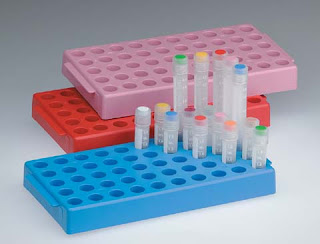
Accordingly, we determined to examine this issue by incubating frozen PBMC samples at -114°C for a longer period (e.g., 48 hours) and then returning them to -150°C. Apoptosis values were considerably higher from PBMC samples held at -114°C than in PBMCs stored for the extent of the experiment at -150°C.
Wednesday, November 19, 2008
Increasing Sample Storage Temperature Above -132°C (Glass Transition Temperature of Water [GTTW]) - Part One
The vapor phase of liquid nitrogen LN2 (-150°C)is typically used to store PBMC’s. It is quite possible that Cryopreserved samples could possibly be frequently exposed to GTTW during retrieval of specimens, particularly from large active cryogenic repository collections. We have determined the rate and the degree that frozen samples will warm when removed from a liquid nitrogen freezer. A freezer rack enclosing mock samples was removed and laid on the top of an open liquid nitrogen freezer. With our computerized freezer monitoring system, we demonstrated that the mock samples' temperature had increased by between 14°C to 55°C, after just 5 minutes in this position, which equaled an average temperature of -114°C. This rise was well above the GTTW (-132°C).
Check back for more about GGTW!
Tuesday, November 18, 2008
The Dangers of Overfilling your Cryogenic Dewar - Part Two

Overfilling problems occur When LN2 liquid nitrogen contacts with the pumpout plug or body for an extensive period of time. Extreme cold temperatures cause the o-rings to contract and harden, which can cause the o-rings to temporarily lose their sealing properties. Since all manufacturers utilize the same o-ring design, this problematic scenario can occur on any liquid nitrogen dewar. The plastic cap will not stop this from happening but will lengthen the time it takes for failure to initiate. It is vital that the pumpout remains covered. Liquid nitrogen may crack the plastic cap if it is spilled on it, (a sign of improper filling), and therefore a replacement cap should be applied to the pumpout without delay. These caps are inexpensive and MVE will supply replacement pumpout caps when they are needed.
Years ago, MVE made use of a metal cap that held on to the pumpout body. Even though this kept dirt particles from distressing the o-rings, it did not alleviate pressure sufficiently and became a liability matter. For a short while, we used a hard plastic cover that relieved pressure but did not guard the plug from dirt. The design we presently use appears to be the safest and easiest method of shielding the o-rings without adding to the cost of the liquid nitrogen dewar. Although there are different styles, depending on the manufacturer, this appears to be the common design practiced throughout the industry. This filling safeguard is particularly significant on liquid nitrogen vapor shippers where the margin for failure recovery is even less. Liquid nitrogen vapor shippers are usually warm when LN2 liquid nitrogen charging is required. Because of the smaller inner volume and the additional liner to be cooled down, the initial flash off is far greater then if the liquid nitrogen dewar was cold. It is due to this fact that the liquid nitrogen vapor shippers usually require additional filling during the charging cycle. Proper filling directions are listed in the manuals provided with each MVE liquid nitrogen dewar, both liquid and vapor.
Visit Princeton CryoTech for more useful articles!
Monday, November 17, 2008
The Dangers of Overfilling your Cryogenic Dewar - Part One
Customers occasionally express concern due to a sudden vacuum loss to a liquid nitrogen dewar. Such liquid nitrogen dewars were returned and immediately checked, then revacuumed and LN2 liquid nitrogen tested. Incorrect filling procedures, such as overfilling, were the main causes of the vacuum losses. This article explains why it is very important to follow careful filling protocol. I am addressing the issue in this month's Tech Tip to help explain why overfilling liquid nitrogen dewars during the charging process is damaging to the vacuum integrity of the aluminum liquid nitrogen dewar.

The pumpout plug has two purposes. The main and most obvious purpose is to preserve the vacuum in the liquid nitrogen dewar’s annular space. Provided that a vacuum is present, the pumpout plug will remain inserted into the pumpout body. The second purpose is to perform as a pressure relief plug in the occurrence of a ruinous inner leak. A leak developing to the inner section of the liquid nitrogen dewar would allow liquid nitrogen to enter the annular space, causing the plug to fall out and relieve any pressure build up. When the liquid nitrogen evaporates into a gas and begins to expand, a pressure increase in the annular space is created. Two o-rings seal the plug to the pumpout body, and are coated with a vacuum grease film to guarantee longevity. The pumpouts are then covered with a flexible composite cap which keeps dirt and contaminates from disturbing the o-rings.
Visit Princeton CryoTech for information and products!
Thursday, September 4, 2008
How Cold is Cold???
Liquid Nitrogen is -196 Centigrade, -320 Fahrenheit. Your skin is about 99 Fahrenheit. So we have about a 420 degree difference between skin and LN2. Now, LN2 IS dangerous, it is used to basically freeze off warts, moles, etc. It burns. However, it actually takes longer than you think to do this. Essentially, to burn the skin you have to drain the energy (heat) out of the it using LN2. A splash of LN2 is on your skin for just a fraction of a second, in that time, very little energy was actually lost and the LN2 has basically flashed off, so you need more LN2 to cool the skin. Couple this with the layer of oil that is on your skin that the LN2 has to cool down and/or move first, and you'd be amazed at how you can pull a dollar bill out of a container of LN2 with your bare hands never even getting wet?
Tuesday, September 2, 2008
Liquid Nitrogen: Under Pressure
Liquid Nitrogen, or LN2, expands to something like 700 times (estimate) its capacity from a liquid to a gas. This means that if you put 1 liter of liquid nitrogen into a space, seal it, then the LN2 warms to a gas, it's going to expand to around 700 liters of nitrogen gas when it reaches 70 degrees F. Basically, without knowing it, someone may create a pressure bomb that can be VERY, VERY dangerous. For this reason we have pressure relief devices (PRDs) on all LN2 systems; when the pressure in the system exceeds the PRDs limit, the PRD vents the excess gas out of the system, thereby maintaining a specific pressure in the system. Without this, things would definitely explode. For instance, a small amount of LN2 inside a capped plastic soda bottle would definitely take your hand off if you were holding it.
Subscribe to:
Posts (Atom)