Showing posts with label freezer racks. Show all posts

Friday, December 12, 2008

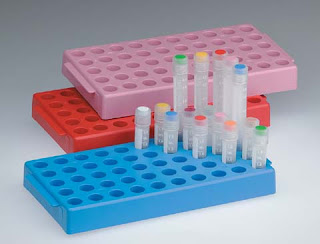
Freezer Racks Question and Answer

Q: Will the evaporation rate decrease if 6 more freezer racks are added?

A: No. Adding more freezer racks increases the heat transfer paths to LN2 as well as the evaporation rate. This is apparent when aluminum vertical freezer racks are being used since aluminum has a greater thermal conductivity than stainless steel. The result of evaporation rate is minimal when stainless freezer racks are being used. There is an added benefit to using aluminum freezer racks though; because of a slightly higher evaporation rate, the cryogenic freezer is filling slightly more frequently, essentially ‘charging’ the liquid nitrogen vapor with a fresh, cooler supply, meaning that the vapor temperatures inside your vapor phase freezer will be slightly cooler when using aluminum freezer racks.

Monday, December 8, 2008

Question and Answer - Cryogenic Freezers and Controllers

Q: I am informed that Japan operates on a 100V supply with their West Coast on 60Hz and their East Coast on 50Hz.  I tried to adjust the LN2 temperature for both cryogenic freezer probes A & B and in both cases it displayed (LN2 aborted). Next I went into the maintenance menu and discovered that LN2 was –273.1C. I rebooted the controller and found the same LN2 temperature.  Please explain how this reading occurred and how to correct the problem?


A: As per our reference material, it indicates that Japanese standard is 100-110VAC, 50-60Hz. The power supply used for Japan on the unit in question and in US for domestic applications is the same. It is made to function with US domestic standard nominal of 120VAC 60Hz. The tolerance on US domestic power is +/- 10% and on the low side it would be ~108VAC. The frequency would not be an issue because the power supply uses an unregulated step down transformer further negation of frequency issue, taking power supply to consideration, the controller rectifies it to DC internally and output is AC. From their outlets, if they are really getting only 100VAC then the output from the power supply to the control would be -20VAC. This would be trivial to properly operate the controller, so this should not cause the issue that is mentioned here.  If low voltage had been the issue, the controller would just shut off to a certain threshold voltage, which should be around the 20-21VAC point from the power supply to the control.


To correct this issue, you can replace the existing power supply with the new power supply which is currently use on the MDD units. It will provide the required output voltage with any input voltage from 100 to 250VAC and 50-60Hz since it built-in detector and switching device and is designed to accommodate +/-10%.  The MDD power supply should operate with an input as low as 90VAC or as high as 275VAC. It has been subjected to these extremes by TUV to be eligible for use in the MDD units. If you decide to install this power supply to sort out this issue, then P/N’s required to make the swap are as follows:


11795030 POWER SUPPLY 30VDC 1.2A 1 EA.

11859030 BRACKET POWER SUPPLY JEROME CE 1 EA.

11859021 BRACKET ADAPTOR FOR JEROME PS 1 EA.

2912191 PHPNHMS 4 EA.

Thursday, December 4, 2008

Design Change for SC/3, SC8/5 and SC11/7

Design Change:

The new cork and cover design has been changed for SC/3, SC8/5 and SC11/7. A hinged base and cover has replaced slotted aluminum cover and the cork/cover is separated from the hinged lid. This shares the same cover assembly as Millennium and Doble units. The new part numbers are (Flat cork/cover 11209791), (Lid cover 5618176), (Hinge pin 5618156), (Hinged neck ring 5618166), (Cork/cover 11853674) (Notched lid for SC3/3 only 11838861) . This change has been in effect from January 2004. The old style replacement cork/covers are available till the unit stock supplies last and it may last through the reminder of 2004 but after which the cork/cover need to be replaced with the hinged lid.


Monday, November 24, 2008

Differences in HE Versions - Liquid Nitrogen Freezers

There has been some confusion about the different HE versions, these differences are outlined below.

  • HE – Operates at -150°C, stainless steel turntable with pie shaped divisions
  • HE+ – Same as HE except has more usable height and aluminum turntable
  • HE Gen 2 – Same as HE except the turntable has rectangular divisions
  • HE+ Gen 2– Same as HE Gen2 except has more usable height
  • ETERNE – Operates at -190°C, aluminum turntable with pie shaped divisions

Friday, November 21, 2008

Increasing Sample Storage Temperature Above -132°C (Glass Transition Temperature of Water [GTTW]) - Part Two

Given these striking temperature effects observed with mock samples, we cycled viably cryopreserved PBMCs through the GTTW to observe the effects oh apoptosis. Using a programmable rate-controlled liquid nitrogen freezer, we exposed PBMC samples to one entire cycle of temperature change (-150°C to -114°C) for 10 min and then back to -150°C. Next, we exposed aliquots to multiple temperature cycles (10, 20 and 40). All samples were then assessed for the incidence of apoptosis using Hoechst staining. There was no considerable difference in the number of positively stained cells (% apoptotic nuclei) from PBMCs stored at -150°C compared to those that underwent 1, 10, 20 and 40 multiple temperature cycles.


Accordingly, we determined to examine this issue by incubating frozen PBMC samples at -114°C for a longer period (e.g., 48 hours) and then returning them to -150°C. Apoptosis values were considerably higher from PBMC samples held at -114°C than in PBMCs stored for the extent of the experiment at -150°C.


Our information illustrates that, when exposed to a warmer temperature for 48 hours, the quality of cryopreserved samples was negatively affected. We conclude that apoptosis occurred due to temperature fluctuations around the GTTW (-132°C). Similar findings were discovered when PBMCs where stored at -80°C for 48 hours. 

Wednesday, November 19, 2008

Increasing Sample Storage Temperature Above -132°C (Glass Transition Temperature of Water [GTTW]) - Part One

The vapor phase of liquid nitrogen LN2 (-150°C)is typically used to store PBMC’s. It is quite possible that Cryopreserved samples could possibly be frequently exposed to GTTW during retrieval of specimens, particularly from large active cryogenic repository collections. We have determined the rate and the degree that frozen samples will warm when removed from a liquid nitrogen freezer. A freezer rack enclosing mock samples was removed and laid on the top of an open liquid nitrogen freezer. With our computerized freezer monitoring system, we demonstrated that the mock samples' temperature had increased by between 14°C to 55°C, after just 5 minutes in this position, which equaled an average temperature of -114°C. This rise was well above the GTTW (-132°C).

Check back for more about GGTW!


Tuesday, November 18, 2008

The Dangers of Overfilling your Cryogenic Dewar - Part Two


Overfilling problems occur When LN2 liquid nitrogen contacts with the pumpout plug or body for an extensive period of time. Extreme cold temperatures cause the o-rings to contract and harden, which can cause the o-rings to temporarily lose their sealing properties. Since all manufacturers utilize the same o-ring design, this problematic scenario can occur on any liquid nitrogen dewar. The plastic cap will not stop this from happening but will lengthen the time it takes for failure to initiate. It is vital that the pumpout remains covered. Liquid nitrogen may crack the plastic cap if it is spilled on it, (a sign of improper filling), and therefore a replacement cap should be applied to the pumpout without delay. These caps are inexpensive and MVE will supply replacement pumpout caps when they are needed.


 Years ago, MVE made use of a metal cap that held on to the pumpout body. Even though this kept dirt particles from distressing the o-rings, it did not alleviate pressure sufficiently and became a liability matter. For a short while, we used a hard plastic cover that relieved pressure but did not guard the plug from dirt. The design we presently use appears to be the safest and easiest method of shielding the o-rings without adding to the cost of the liquid nitrogen dewar. Although there are different styles, depending on the manufacturer, this appears to be the common design practiced throughout the industry. This filling safeguard is particularly significant on liquid nitrogen vapor shippers where the margin for failure recovery is even less. Liquid nitrogen vapor shippers are usually warm when LN2 liquid nitrogen charging is required. Because of the smaller inner volume and the additional liner to be cooled down, the initial flash off is far greater then if the liquid nitrogen dewar was cold. It is due to this fact that the liquid nitrogen vapor shippers usually require additional filling during the charging cycle. Proper filling directions are listed in the manuals provided with each MVE liquid nitrogen dewar, both liquid and vapor.


Visit Princeton CryoTech for more useful articles!

Monday, November 17, 2008

The Dangers of Overfilling your Cryogenic Dewar - Part One

Customers occasionally express concern due to a sudden vacuum loss to a liquid nitrogen dewar. Such liquid nitrogen dewars were returned and immediately checked, then revacuumed and LN2 liquid nitrogen tested. Incorrect filling procedures, such as overfilling, were the main causes of the vacuum losses. This article explains why it is very important to follow careful filling protocol. I am addressing the issue in this month's Tech Tip to help explain why overfilling liquid nitrogen dewars during the charging process is damaging to the vacuum integrity of the aluminum liquid nitrogen dewar.

The pumpout plug has two purposes. The main and most obvious purpose is to preserve the vacuum in the liquid nitrogen dewar’s annular space. Provided that a vacuum is present, the pumpout plug will remain inserted into the pumpout body. The second purpose is to perform as a pressure relief plug in the occurrence of a ruinous inner leak. A leak developing to the inner section of the liquid nitrogen dewar would allow liquid nitrogen to enter the annular space, causing the plug to fall out and relieve any pressure build up. When the liquid nitrogen evaporates into a gas and begins to expand, a pressure increase in the annular space is created. Two o-rings seal the plug to the pumpout body, and are coated with a vacuum grease film to guarantee longevity. The pumpouts are then covered with a flexible composite cap which keeps dirt and contaminates from disturbing the o-rings.


Visit Princeton CryoTech for information and products!

Thursday, September 4, 2008

How Cold is Cold???

Liquid Nitrogen is -196 Centigrade, -320 Fahrenheit. Your skin is about 99 Fahrenheit. So we have about a 420 degree difference between skin and LN2. Now, LN2 IS dangerous, it is used to basically freeze off warts, moles, etc. It burns. However, it actually takes longer than you think to do this. Essentially, to burn the skin you have to drain the energy (heat) out of the it using LN2. A splash of LN2 is on your skin for just a fraction of a second, in that time, very little energy was actually lost and the LN2 has basically flashed off, so you need more LN2 to cool the skin. Couple this with the layer of oil that is on your skin that the LN2 has to cool down and/or move first, and you'd be amazed at how you can pull a dollar bill out of a container of LN2 with your bare hands never even getting wet?

Tuesday, September 2, 2008

Liquid Nitrogen: Under Pressure

Liquid Nitrogen, or LN2, expands to something like 700 times (estimate) its capacity from a liquid to a gas. This means that if you put 1 liter of liquid nitrogen into a space, seal it, then the LN2 warms to a gas, it's going to expand to around 700 liters of nitrogen gas when it reaches 70 degrees F. Basically, without knowing it, someone may create a pressure bomb that can be VERY, VERY dangerous. For this reason we have pressure relief devices (PRDs) on all LN2 systems; when the pressure in the system exceeds the PRDs limit, the PRD vents the excess gas out of the system, thereby maintaining a specific pressure in the system. Without this, things would definitely explode. For instance, a small amount of LN2 inside a capped plastic soda bottle would definitely take your hand off if you were holding it.